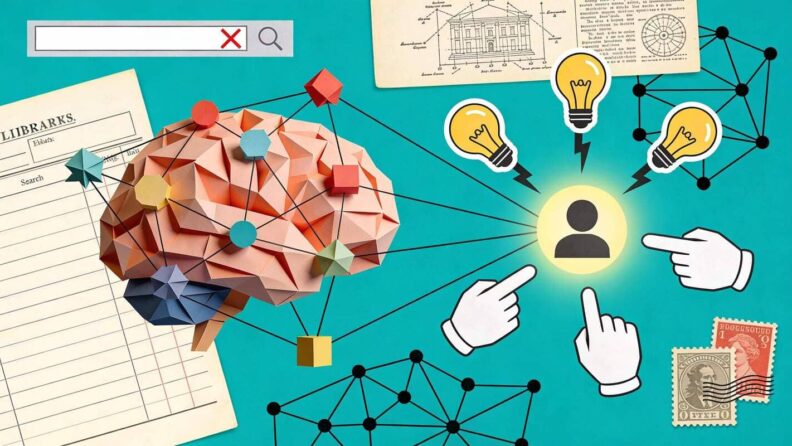
Google doesn’t “read” your content the way you think it does. For over a decade, it’s been building a database of real-world things — people, companies, concepts, places — and ranking based on what it knows about them. Understanding this changes everything about how you optimise.
By Matthis Duarte — Senior SEO professional, 12 years experience
In 2012, Google’s CEO Eric Schmidt made a statement that most marketers at the time didn’t take seriously enough: “The search engine of the future is not about keywords — it’s about things.”
He was referring to the launch of the Google Knowledge Graph: a structured database of real-world entities and the relationships between them. At launch, it contained 500 million entities. As of mid-2024, it contains 54 billion entities and over 1.6 trillion facts — and it grows every day.
This database is the foundation of modern search. When you understand how it works, you stop thinking about keywords and start thinking about what your brand, your content, and your topics represent as entities in Google’s world model.
What an entity is — and why it matters for search
In Google’s framework, an entity is any clearly defined, real-world thing: a person, a company, a product, a concept, a place, an event. Entities are distinct from keywords because they have identity — they can be referenced, described, and connected to other entities without relying on specific word patterns.
When you search “Elon Musk net worth,” Google doesn’t need to find a page that contains the exact string “Elon Musk net worth.” It knows Elon Musk is an entity. It knows that entity has attributes (net worth, company affiliations, biography). It retrieves those facts from its Knowledge Graph and surfaces them directly.
Entity SEO is the practice of ensuring that Google correctly understands, associates, and trusts the entities connected to your site — your brand, your topics, your key people, and your product. It’s not about keyword optimisation at the page level. It’s about establishing who you are and what you know at the semantic web level.
The three layers of entity optimisation
1. Brand entity — making Google recognise your company
Your brand is an entity. When it’s properly established in Google’s Knowledge Graph, your business name triggers a Knowledge Panel in search results — the box on the right side of Google showing your logo, description, founding date, social profiles, and related entities.
Knowledge panels are not just cosmetic. They signal trust. They dominate screen real estate. And according to recent data, knowledge panel links earn a 38% average CTR — higher than the standard position 1 organic result at around 28%. [verify]
To build your brand entity:
- Claim and complete your Google Business Profile if applicable
- Create and maintain consistent profiles on entity-recognition sources: Wikidata, Crunchbase, LinkedIn, and Wikipedia (if you qualify)
- Add Organisation schema (JSON-LD) to your homepage with
sameAsattributes pointing to these profiles — this tells Google’s crawler which profiles across the web all refer to the same entity
Consistency across all these touchpoints is critical. If your company name, description, and founding date differ across sources, Google can’t confidently merge them into a single entity record — and your Knowledge Panel either doesn’t appear or shows incorrect information.
2. Topical entity — what subjects does Google associate you with?
Every piece of content you publish is a signal about which topical entities your site is connected to. A site that consistently publishes about SEO, growth hacking, and AI visibility is building entity associations with those concepts. Google starts to understand: this site is authoritative about these things.
This is the deeper mechanism behind topical authority. It’s not just about keyword frequency — it’s about the density of entity associations your site builds over time in relation to a topic cluster.
Practically, this means:
- Every article should clearly establish the entities it covers (by naming them explicitly — people, brands, tools, frameworks)
- Use schema markup (
schema.org/Article,schema.org/Person,schema.org/Product) to explicitly declare what each page is about - Reference well-known entities within your niche — not just for backlinks, but to signal semantic co-occurrence (if Google already knows what Entity X is, and you reference it correctly, some of that trust transfers)
3. Content entity clarity — one page, one unambiguous concept
Google’s entity-first framework penalises ambiguity. A page that tries to cover three different concepts is harder for Google to classify as authoritative on any of them.
The principle: each page should be unambiguously about one entity or concept. The title tag, H1, URL slug, and schema mainEntityOfPage property should all reinforce the same concept. When they align, Google can confidently assign that page to a specific entity in its graph — which is the foundation of earning a featured snippet, an AI Overview mention, or a Knowledge Panel inclusion.
How entity SEO connects to AI visibility
This is where entity SEO becomes essential for the next decade of search.
Large language models — ChatGPT, Gemini, Perplexity — are trained on the same corpus of structured data that powers Google’s Knowledge Graph. They absorb Wikidata entity records, schema markup patterns, and the semantically rich content that surrounds well-established entities.
When you build entity clarity for Google (structured data, consistent profiles, unambiguous page focus), you’re simultaneously improving your chances of being cited by AI search engines. The overlap between “entities Google trusts” and “entities LLMs reference” is very high and growing.
“Entity optimisation is no longer just a Google play. It’s the foundational layer of visibility in any search environment — traditional or AI-native.”
An entity-optimised brand that appears in Google’s Knowledge Graph, has verified profiles on Wikidata and Crunchbase, and publishes clearly structured content will be more reliably cited by AI search tools than an equally competent brand that Google can’t quite classify.
The practical entity SEO checklist
| Area | Action | Tool |
|---|---|---|
| Brand entity | Add Organisation + sameAs schema to homepage | schema.org/Organization |
| Brand entity | Create/claim Wikidata entry if eligible | wikidata.org |
| Brand entity | Complete Crunchbase and LinkedIn profiles | crunchbase.com, linkedin.com |
| Topical entity | Add Article schema to all blog posts | schema.org/Article |
| Content clarity | One clear entity per page — align title, H1, URL, schema | N/A |
| Knowledge Panel | Submit entity claim via Google Search Console | Google Business Profile |
| Author entity | Add Person schema to author bio pages | schema.org/Person |
💡 Want to build your brand and topical entity authority from scratch?
Entity optimisation is one of the most underutilised strategies for startups — and one of the highest-leverage plays for both Google rankings and AI Visibility. The Search & AI Visibility Diagnostic includes a full AI visibility audit (ChatGPT, Gemini, Perplexity gaps) and entity signal analysis — so you know exactly where you’re invisible and what to fix. Book a discovery call → ($7,000 one-time — delivered in 14 days)
Key takeaways
- ✓ Google’s Knowledge Graph contains 54 billion entities and 1.6 trillion facts — understanding entities is how modern Google actually works, not keyword matching
- ✓ Brand entity optimisation (schema, Wikidata, Crunchbase, sameAs) is the foundation for triggering a Knowledge Panel and earning AI Overviews visibility
- ✓ Each page should be unambiguously about one entity — title, H1, URL, and schema all pointing to the same concept
- ✓ Entity SEO directly overlaps with AI Visibility — entities Google trusts are the same entities LLMs reference in AI search answers
- ✓ The practical starting point: add Organisation schema with sameAs to your homepage, create consistent profiles on entity-recognition sources, and add Article schema to every blog post
Matthis Duarte is a senior SEO professional with 12 years of experience. HackingStory.com reverse-engineers how the fastest-growing startups actually grew — with real data, not press releases.