Publishing blog posts one by one and hoping they rank is not a content strategy — it’s content chaos. Here’s the architecture that turns a collection of articles into a ranking machine.
By Matthis Duarte — Senior SEO professional, 12 years experience
Most startup blogs are a mess of unconnected articles. An article about pricing strategy. One about customer acquisition. One about product-market fit. Then three random posts about AI tools. Each one exists in isolation, pointing nowhere, supported by nothing, quietly dying in the index.
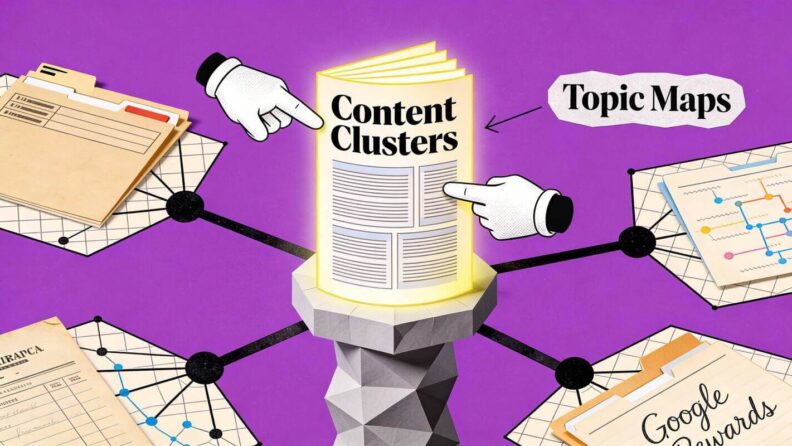
This is not what content marketing looks like when it works. When it works, it looks like an architecture — a deliberate structure of interconnected pages where each article reinforces every other article on the same topic. Google doesn’t just see individual pages. It sees a network. And the denser and better-connected your network is on a given topic, the more it trusts your site as an authority.
That architecture has a name: the content cluster. And understanding how to build one is the difference between a blog that compounds over time and one that flatlines.
What a content cluster is
A content cluster (also called a topic cluster) is a group of web pages built around a single broad subject, organised into two types of content:
The pillar page — a long, comprehensive page that covers the broad topic at a high level. It’s your definitive guide to the subject. It links out to every related article in the cluster, and every article in the cluster links back to it. Think of it as the hub.
Cluster articles — individual, focused articles that each go deep on one specific subtopic within the broader theme. They’re the spokes. Each one explores an angle that the pillar page mentions but doesn’t fully cover.
The concept was popularised by HubSpot around 2017, when their team published research showing that Google’s algorithm was shifting from keyword matching to topic understanding — and that the sites with the most organised, interconnected topic coverage were winning.
“A content cluster is not a content calendar. It’s a decision about which topics you want to own — and a commitment to covering them completely before moving on.”
The anatomy of a cluster — what it looks like in practice
Take “SaaS SEO” as the pillar topic. Your pillar page covers: what is SaaS SEO, why it’s different from regular SEO, the key strategies, and a high-level overview of the tactics. It mentions keyword research, topical authority, programmatic SEO, technical SEO, link building — but doesn’t go deep on any of them.
Each of those subtopics becomes a cluster article:
- Keyword research for SaaS startups (deep dive)
- Topical authority for SaaS (deep dive)
- Programmatic SEO examples for SaaS (deep dive)
- Technical SEO checklist for SaaS products (deep dive)
- Link building strategies for B2B SaaS (deep dive)
The pillar page links to each of these articles with descriptive anchor text. Every cluster article links back to the pillar. The result is a tightly woven content network where Google can follow the relationships between every page and understand your depth of coverage.
Why this structure works
The internal linking architecture of a content cluster does something individual pages cannot do alone: it passes authority and context simultaneously.
When the pillar page links to a cluster article with anchor text like “keyword research for SaaS,” that link tells Google two things: (1) this cluster article is about keyword research for SaaS, and (2) it’s connected to a broader topic cluster about SaaS SEO. The cluster article is not a random page — it’s part of a network, contextualised by its neighbours.
The data supports this. Recent analysis of clustered versus standalone content found that pages organised into clusters generate roughly 30% more organic traffic and hold rankings 2.5x longer than equivalent pages published in isolation.
This is because topical authority (the topic-level trust signal Google assigns to your site) compounds within a cluster. Add a new, relevant cluster article, and the entire cluster gets a lift — not just the new page.
How many articles do you need per cluster?
The practical threshold is 8 to 15 cluster articles per pillar to achieve meaningful topical coverage. Below 8, the cluster is too thin to signal comprehensive coverage. Above 20, you’re likely drifting into sub-topics that deserve their own cluster.
| Cluster size | Status | Expected effect |
|---|---|---|
| 1–4 articles | Insufficient | Little to no topical authority signal |
| 5–8 articles | Building | Some rankings lift, unstable |
| 8–15 articles | Effective range | Clear topical authority emerging |
| 15–25 articles | Strong | Dominant for most niche topics |
| 25+ articles | Comprehensive | Highly competitive niche dominance |
The key constraint: complete one cluster before starting another. Spreading content evenly across three half-finished clusters is the most common mistake. A complete cluster of 12 articles on one topic will outrank three separate clusters of 4 articles each every time.
How to build a content cluster — step by step
Step 1 — Choose your pillar topic
Pick a subject broad enough to support 10+ subtopics, but narrow enough that it’s actually relevant to your product or audience. “Marketing” is too broad. “SEO for B2B SaaS” is right-sized.
Step 2 — Map every subtopic
Brainstorm every question someone interested in your pillar topic might ask. Use Google’s “People Also Ask” boxes, Ahrefs keyword explorer, and your sales/support team’s frequently asked questions. Every answerable question is a potential cluster article.
Step 3 — Write the pillar page first
The pillar page sets the architecture. Write it as a comprehensive overview (2,000–3,500 words), covering every subtopic at a high level, with clear sections for each. Leave placeholders for the internal links you’ll add as cluster articles go live.
Step 4 — Publish cluster articles in batches
Don’t publish articles one per month and wait. Publish in batches of 3–5 articles at a time to accelerate Google’s understanding of the cluster. Each time you add a batch, update the pillar page with new internal links.
Step 5 — Maintain consistent internal linking
Every cluster article must link back to the pillar. The pillar must link to every cluster article. Use descriptive, keyword-relevant anchor text — not generic “click here” links. Google’s own guidance on internal linking confirms that anchor text signals context to crawlers.
💡 Want a ready-to-execute content cluster mapped out for your business?
The Search & AI Visibility Diagnostic delivers a 90-day editorial plan built around the exact content clusters you need to own — pillar topics selected, cluster articles mapped, priorities set by revenue impact. If you want to stop publishing articles into a void and start building a compounding content asset, this is where to start. Book a discovery call → ($7,000 one-time — delivered in 14 days)
Key takeaways
- ✓ A content cluster groups a pillar page and 8–15 focused cluster articles into a linked network — Google rewards the depth and organisation with higher topical authority
- ✓ Internal links are the connective tissue: every cluster article links to the pillar, and the pillar links to every cluster article, with descriptive anchor text
- ✓ Complete one cluster before starting another — a cluster of 12 articles on one topic outranks three clusters of 4 articles each
- ✓ Clusters generate ~30% more organic traffic and hold rankings 2.5x longer than equivalent standalone articles
- ✓ The pillar page defines the architecture — write it first, leave space for internal links, and update it with each new batch of cluster articles
Matthis Duarte is a senior SEO professional with 12 years of experience. HackingStory.com reverse-engineers how the fastest-growing startups actually grew — with real data, not press releases.